
What Exactly Is Data Annotation?
Data Annotation is the process of labeling or tagging data to make it understandable for machine learning models. It involves adding metadata, such as bounding boxes, labels, or keywords, to various forms of data like text, images, audio, or video.
The goal is to provide a “ground truth” that machine learning algorithms can use to learn patterns, enabling them to recognise, categorise, and make predictions on new, unlabeled data. This process is essential for supervised machine learning, as it provides the necessary context for models to learn effectively.
It’s the process of labeling or tagging raw data like images, videos, audio, or text to make it recognisable to a computer.
Imagine you are trying to teach a child.
You’d show them pictures of cats and say, “That’s a cat.” You might also point out their ears, whiskers, and tail. Data annotation is basically the same process, but for machines.
Without data annotation, these technologies simply would not exist. It’s the critical first step in building any AI or machine learning model.
Why Is Data Annotation So Important?
The quality of the data used to train a model directly impacts its performance. High-quality, accurately annotated data is essential for building a reliable and effective AI system.
- Training a model: An AI model learns from the examples we give it. Just like a student needs good textbooks and clear examples to learn a subject, an AI model needs well-labelled data to learn to recognise patterns and make accurate predictions.
- Improving accuracy: If the data is poorly labeled, the model will learn incorrect information, leading to mistakes. For example, if a self-driving car’s training data incorrectly labels stop signs, it could lead to dangerous situations.
- Enabling new technologies: From a simple spam filter in your email to sophisticated medical diagnostic tools, data annotation is what makes these innovations possible. It’s the human input that teaches the machine what to look for.
Different Types of Data and Annotation
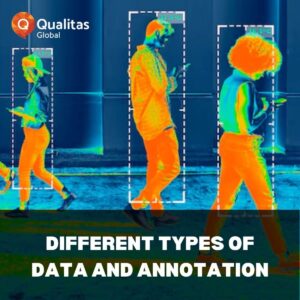 Data annotation isn’t a one-size-fits-all process. The type of annotation depends on the data and the AI model’s purpose.
- Image and Video Annotation: This is where we label objects in images or videos. Common techniques include:
- Bounding Boxes: Drawing a box around an object.
- Polygons: Tracing the exact shape of an object for more precise identification.
- Semantic Segmentation: Labeling every pixel in an image to belong to a specific category (e.g., sky, road, car). This is crucial for self-driving cars to understand their environment.
- Text Annotation: This involves labeling text to help machines understand language.
- Sentiment Analysis: Labeling a piece of text as positive, negative, or neutral. This is used in customer feedback analysis.
- Named Entity Recognition (NER): Identifying and labeling key entities in a text, such as names, places, and organisations.
- Audio Annotation: This is the process of labeling and transcribing audio data. This is how virtual assistants like Siri or Alexa can understand your voice commands.
The Human Factor: The Role of Annotators
While we are talking about machines, it is important to remember that data annotation is a human-driven process. The people who do this work, often called data annotators, are the ones meticulously labeling the data. Their attention to detail and accuracy is what makes the whole system work.
Qualitas Global specialise in providing these services, employing teams of skilled annotators to ensure the highest quality data. They work on large-scale projects, helping businesses around the world get the clean, labelled data they need to build powerful AI applications.
The Future of Data Annotation
As AI becomes more integrated into our lives, the demand for high-quality labeled data will only grow. The field of data annotation is constantly evolving, with new tools and techniques emerging to make the process more efficient and accurate.
From helping doctors diagnose diseases to making our daily commutes safer, data annotation is the unsung hero behind the AI revolution. It’s a foundational process that bridges the gap between raw data and intelligent machines, proving that even in the age of AI, the human touch remains indispensable.